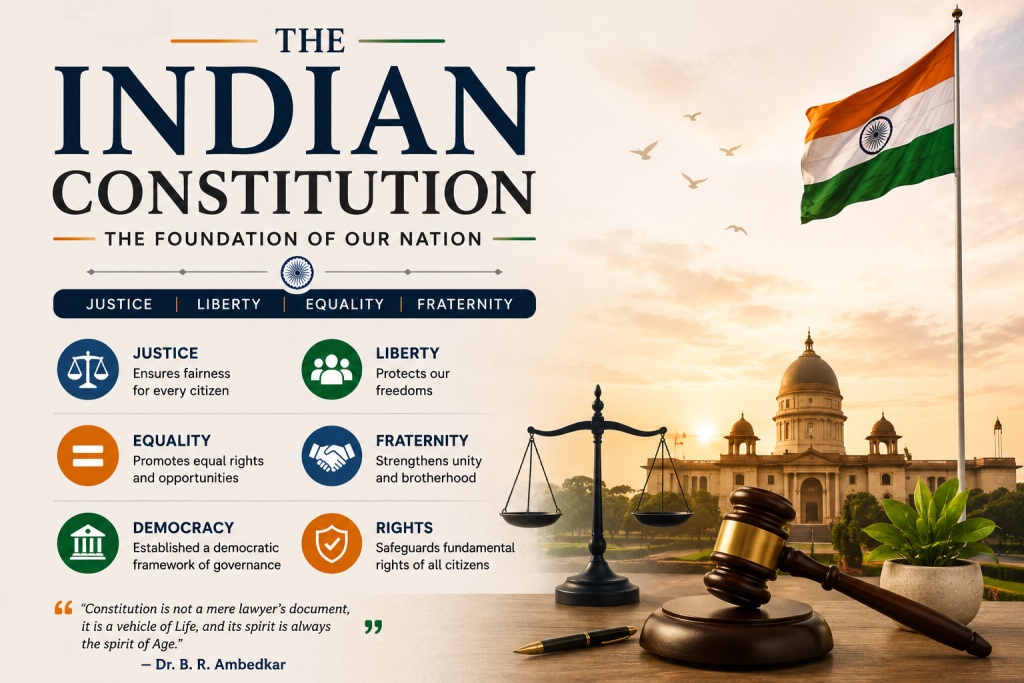
The Indian Constitution is the bedrock of Indian democracy. It tells how the country is governed, how power is distributed, what rights citizens have, and what duties governments must follow. It is far more than just a legal document. It lays down the ground rules of running the country and enshrines critical values like justice, liberty, equality and fraternity.
The Constitution was accepted by the Constituent Assembly on 26 November 1949, and it became active on 26 January 1950. The official Legislative Department is now issuing the Constitution of India in a 2026 edition, demonstrating that the text is still valid and is being published with updates as changes come into law.
But how did this document come about? What is actually in it? What does it mean to the average citizen? Let’s break it down.
What Is the Indian Constitution?
The Constitution of India is the supreme law of the land. To put it simply, it is the master rule for the nation. It defines how the government is set up and defines Parliament, executive and court powers. It provides citizens with constitutional guarantees.
The Supreme Court of India refers to the Constitution as the ultimate rule book that governs the legislature, executive and judiciary. It also emphasizes its point about protecting Fundamental Rights, allowing for an independent court system and laying down the groundwork for a federal structure in the country.
Constitutions are not just about rules, of course. But think about a school.
A school needs rules about:
- Who runs the school
- What teachers are allowed to do
- What students can expect
- How decisions get made
- What happens if someone breaks a rule
A country needs rules, too. The Constitution provides that rule book for India. It defines what governments can do, what they can’t do and how all the different arms of government are supposed to work.
When Was the Constitution of India Created?
The history of the Constitution dates back to before independence. The Constituent Assembly had been established to write a Constitution for free India. Its first session was on 9 December 1946. Dr. Rajendra Prasad was elected as its permanent President. It had representatives from various regions of India and functioned through discussions and sub-committees.
A significant event took place on 29 August 1947, when the Drafting Committee was established with Dr. B. R. Ambedkar as Chairman.
The Assembly discussed many challenging issues, like:
- How would power be shared between the Centre and the states?
- What rights should citizens have?
- How should minorities be treated?
- What system of government should India have?
- How could democracy function in a country with vast social and cultural diversity?
After intense debates, the Constitution was finally accepted on 26 November 1949 and came into effect on 26 January 1950. That is why India observes:
- 26 November: Constitution Day
- 26 January: Republic Day
Who Wrote the Indian Constitution?
People often say that Dr. B. R. Ambedkar “wrote” the Constitution. This needs some clarification.
Dr. B. R. Ambedkar was indeed the Chairman of the Drafting Committee, the most significant individual role. But the Constitution was a collective product of the Constituent Assembly, its subcommittees and all those who debated, contributed and helped draft it. Jawaharlal Nehru, Rajendra Prasad, Sardar Vallabhbhai Patel, B. N. Rau and many others all played their part.
Therefore, it is more correct to say that Dr. B. R. Ambedkar was the Chairman of the Drafting Committee and did much of the work on the Constitution himself, rather than to say that he single-handedly wrote the Constitution.
What Does the Preamble Say?
The Preamble is the introduction to the Constitution.
The first words are “We, the People of India.” This is an important phrase because it indicates that all constitutional power ultimately derives from the people.
The Preamble defines India as a:
- Sovereign
- Socialist
- Secular
- Democratic
- Republic
It guarantees:
- Justice
- Liberty
- Equality
- Fraternity
These are not just symbolic words. They summarise the aspirations of the constitutional order.
Justice
Justice is social, economic and political. In broad terms, it ensures that people can participate on an equal basis in the political and social life of the community.
Liberty
Liberty guarantees freedom of thought, expression, belief, faith and worship.
Equality
Equality ensures that people are not treated unfairly just because of who they are.
Fraternity
Fraternity refers to a sense of brotherhood and common humanity. It is linked to individual dignity and national unity. So the Preamble provides an overview of the aspirations of the Constitution.
What Are the Main Features of the Indian Constitution?
The Indian Constitution has a number of significant features. The features of the constitution help you to make sense of the political system.
Parliamentary Government
India has a parliamentary government in which the executive is responsible to the elected legislature. At the Union level, Parliament comprises the President and two Houses: the Lok Sabha and the Rajya Sabha. This arrangement produces an interaction between the legislature and executive which is different from a presidential system.
Federal Structure
India has a Union, state and locally (by the Constitution) recognized governments. Powers are distributed between the Union and the states. At the same time, the Constitution vests enormous powers in the Union. This is why Indian federalism is said to have federal and unitary characteristics. A recent short-hand introduced in educational guides also lists federal structure, strong Centre and integrated institutions as significant features.
Independent Judiciary
The court system is hugely significant in upholding the constitution. The Supreme Court and High Courts are allowed to review legislation and executive actions, where relevant. It would be of little value, however, to have rights guaranteed in the constitution if there were no independent body to uphold those rights.
Fundamental Rights
The constitution guarantees certain rights to citizens which protect individual liberty and equality.
Directive Principles
The constitution includes mandates for government policies with an emphasis on social and economic issues.
Fundamental Duties
There are duties that citizens must adhere to; this emphasizes the responsibilities of individual citizens in the democracy.
Universal Adult Franchise
Indian democracy allows all adult citizens to vote. All citizens should fulfill the requirement of being a voter.
Constitutional Supremacy
Ordinary laws should be within the power of the constitution. If an ordinary law does not conform to constitutionality, the court may examine its validity.
What Are the Fundamental Rights in India?
The Fundamental Rights form a very vital part of the constitution. They enshrine critical liberties and maintain order. They are mainly located in Part III of the Constitution.
| Fundamental Right | Simple Meaning |
| Right to Equality | Equal treatment by the law |
| Right to Freedom | Essential individual liberties |
| Right against Exploitation | Protection from certain types of exploitation |
| Right to Freedom of Religion | Freedom of conscience and religion |
| Cultural and Educational Rights | Protection of certain cultural and educational rights |
| Right to Constitutional Remedies | Right to go to court for enforcement of rights |
Right to Equality
Articles 14 to 18 relate to equality protections. Article 14, for instance, provides equality before the law and equal protection of the law.
Right to Freedom
Articles 19 to 22 contain key protections related to freedom. These protections do not guarantee freedoms unlimited in scope. There are also constitutional limits on rights under certain circumstances. A constitutional right does not necessarily mean a person may exercise it without limit.
Right to Constitutional Remedies
Article 32 is unique. It grants the right to go to Supreme Court to enforce Fundamental Rights, and the Constitution allows the Supreme Court to issue appropriate directions, orders or writs for this purpose. This is why constitutional rights matter.
What Happened to the Right to Property?
This is a typical question. The Right to Property was a Fundamental Right but it is not part of that list today. Instead, we have protection of property under Article 300A. This is just an example of how the Constitution changes through amendments and that not every provision is permanent.
What Are Directive Principles of State Policy?
The Directive Principles of State Policy are in Part IV. They advise the government on making laws and policies. These include:
- Welfare
- Economic justice
- Health
- Education
- Improved working conditions
- Protection of weaker sections
- Equal justice
One key distinction is that Directive Principles are not always legally enforceable like the Fundamental Rights. This does not mean they are of no significance. The Directive Principles help clarify the social and economic purposes the constitutional framework envisages for government action. Courts, notably the Supreme Court, have stressed the significance of the interplay between Fundamental Rights and Directive Principles in understanding the constitutional scheme.
A Simple Example
Let’s say that the government has established some programme to make education or health care more accessible. The policy might represent some constitutional aspiration or requirement that is relevant to the Directive Principles. In this way, then, DPSP can have an impact on government policy even though an individual cannot really go into court and demand that every single provision of the Directive Principles be made enforceable.
What Are Fundamental Duties?
Fundamental Duties reflect responsibilities like:
- Respecting the Constitution, National Flag, and National Anthem
- Environmental protection
- Development of a scientific temper
- Protection of public property
- Striving for excellence
There is also a duty related to giving education to children in the age group specified by law.
The general principle is that while citizens have rights, democracy depends on citizens behaving responsibly. With regard to rights, for example, freedom of expression cannot be absolute because it needs to be balanced with citizens’ responsibility to maintain public order and behave with consideration for other members of the public and the wider community.
How Is the Indian Constitution Organized?
The Constitution is divided into Parts, Articles and Schedules. When the Constitution came into force, it had 395 Articles, 22 Parts and 8 Schedules. Amending has added to and modified its provisions. At present, there are 12 Schedules. The Legislative Department maintains the current text of the Constitution and issues separate amendment Acts.
What Are Schedules?
Schedules include details related to the provisions in the Constitution. They deal with matters like:
- States and Union Territories
- Pay and allowances of certain constitutional functionaries
- Oaths and affirmations
- Seat allocation for the Rajya Sabha
- Scheduled Areas and tribal areas
- Union, State and Concurrent Lists
- Official languages
- Anti-defection provisions
- Panchayats
- Municipalities
The 12 Schedules do not exist outside the Constitution. They are part of the Constitution. In a more recent education session, we explain all 12 Schedules and their purpose.
What Are Some Important Articles of the Indian Constitution?
You do not have to memorize Articles to learn about the Constitution. There are a few important ones to remember as a beginner.
| Article | What It Deals With |
| Article 14 | Equality before law |
| Article 15 | Prohibition of discrimination on specified grounds |
| Article 16 | Equality of opportunity in public employment |
| Article 19 | Important freedoms |
| Article 21 | Protection of life and personal liberty |
| Article 21A | Right to education for children in the specified age group |
| Article 32 | Constitutional remedies |
| Article 44 | Uniform Civil Code as a Directive Principle |
| Article 51A | Fundamental Duties |
| Article 300A | Right to property as a constitutional legal protection |
| Article 368 | Constitutional amendment procedure |
These Articles should not be read in isolation because constitutional provisions often work together. For example, courts have developed important principles by reading rights, government powers and constitutional values together.
Can the Indian Constitution Be Amended?
Yes. A constitution should have permanence but must also be able to deal with changing realities. Article 368 is the principal amendment procedure. Not all constitutional amendments, however, involve hours of identical voting.
Amendment provisions require, depending on the provision:
- A simple majority of votes cast for provisions other than Article 368
- A special majority in Parliament
- A special majority and the approval of half the states in the case of some federal matters
This stability and flexibility characterize the Constitution. The current Legislative Department lists the 106th Constitution Amendment Act, 2023 Act in the Constitution Amendment Acts.
Why Can’t Parliament Change Everything?
That’s where the Basic Structure Doctrine comes in. The Supreme Court laid down in the Kesavananda Bharati case that Parliament’s power to amend the Constitution is not absolute. Broadly speaking, Parliament is allowed to amend the Constitution but not allowed to use that amendment power to change the Constitution’s basic structure.
The basic structure doctrine has been affirmed in subsequent Supreme Court cases. The basic structure of the Constitution is not defined in a single simple checklist found within a single Article, but courts have recognized fundamental constitutional principles like:
- Constitutional supremacy
- Rule of law
- Judicial review
- Democracy
- Secularism
- Federalism
- Separation of powers
- Core constitutional rights and principles
This doctrine establishes an important equilibrium: the Constitution can be amended, but its essential character cannot be eliminated through the amendment process.
Why Is the Indian Constitution Significant?
The Constitution is significant in that it impacts nearly every area of public life.
- It constrains government: Government agencies cannot exercise arbitrary power; their powers are derived from the Constitution itself.
- It provides guarantees: Citizens have entitlements under the Constitution that can be enforced in courts.
- It enables democracy: The Constitution provides the framework for the functioning of elected governments through various institutions and processes.
- It safeguards equality: Constitutional guarantees protect citizens from discrimination and inequality.
- It establishes balances: Institutions have different functions. Parliament makes laws, the executive branch implements laws, and the judiciary interprets the Constitution and reviews the actions of the executive.
- It promotes integration: India is a highly diverse society. The Constitution offers a shared legal and political system across people in different states, with different languages, cultures and communities.
Why Is the Constitution Relevant to Your Daily Life?
You might think that constitutional law applies only to judges, lawyers and politicians. You would be wrong. Here is a simple example. If an individual feels that a governmental decision infringes on a right that is guaranteed to be protected, then the Constitution provides the basis for that individual to challenge the decision through the courts.
Another instance is voting. The constitution provides the democratic process through which governments are formed. Freedom of religion, equal treatment before the law, rights to education, rights to personal freedom and other constitutional provisions influence what people do in their everyday lives. The Constitution may not be visible in your daily activities, but its provisions govern all aspects of modern Indian life.
Indian Constitution vs Ordinary Law
A typical first question from students is: What is the difference between the Constitution and an ordinary law?
An ordinary law is enacted under authority given to Parliament by the Constitution. The Constitution provides the higher legal authority. Parliament may pass an ordinary law on a matter such as taxation, education or any other subject where it has constitutional jurisdiction, but that law must be consistent with any applicable constitutional requirement. If there is a constitutional issue, the courts have jurisdiction to assess validity. This is one reason the Constitution is regarded as the supreme law of India.
Common Myths About the Constitution
- “Dr. Ambedkar wrote the entire Constitution alone.”
Not really. He was the Chairman and primary author, but it was a product of the Assembly and its discussions. - “All constitutional rights are absolute.”
No. Many are operated subject to constitutional conditions and permissible limitations. - “Directive Principles are useless because they cannot be enforced in a court of law.”
Untrue. They have a role to play in guiding the state and are part of the constitutional scheme. Their interaction with Fundamental Rights has been significant too. - “The Constitution can never change.”
Wrong. There have been many amendments to the Constitution; however, the power of amendment has constitutional limits under the Basic Structure Doctrine. - “The Constitution only concerns politicians.”
No. It governs how the government works, guarantees rights and establishes the legal system that affects citizens in their daily lives.
A Simple Way to Study Indian Constitution
If you are a student or a beginner, do not attempt to memorize everything at once. Follow this order:
- Step 1: The Preamble — Learn the meaning of Justice, Liberty, Equality, Fraternity, Sovereign, Socialist, Secular, Democratic, Republic.
- Step 2: The Basic Structure — Learn about the 3 major organs of the state: Legislature (makes laws), Executive (carries out laws), Judiciary (protects your rights, interprets the law).
- Step 3: Study Fundamental Rights — Start with Articles 14, 19, 21 and 32, then study the rest.
- Step 4: Learn DPSP and Fundamental Duties — Know the difference between citizen’s rights, state obligations and duties of the citizens.
- Step 5: Study Important Parts and Schedules — Know what each important Part is about before you memorize every detail.
- Step 6: Study Amendments — Important Amendments to start with are 42nd, 44th, 73rd, 74th, 86th, 101st and 106th Amendments.
- Step 7: Read the Actual Constitution — After doing all the above, reading the actual text from the Legislative Department will be easy.
Why Constitution Day Is Important
India celebrates Constitution Day on 26 November to commemorate the day the Constitution was adopted by the Constituent Assembly in 1949. It’s a time to reflect on constitutional values, not just Articles.
Constitutional law students might want to study its history at this time. Citizens might reflect on how democracy is about more than elections — it’s about rights, institutions, duties and respect for constitutional values.
Frequently Asked Questions
What Is the Constitution of India?
The Constitution of India is the highest law of the land. It governs the government and guarantees Fundamental Rights.
Who is the main person who drafted the Constitution?
Dr. B. R. Ambedkar was the Chairman of the Drafting Committee.
When was the Constitution passed?
The Constitution was passed on 26 November 1949.
When did the Constitution become operational?
It became operational on 26 January 1950.
How many Fundamental Rights are there?
There are six categories of Fundamental Rights. The Right to Property is no longer a Fundamental Right, but it is protected by the Constitution (Article 300A).
Has the Constitution been amended?
Yes. Article 368 lays down the main amendment procedure, though there can be different requirements for different amendments under different provisions of the Constitution.
What is the Basic Structure Doctrine?
It is the doctrine that Parliament’s power to amend the Constitution cannot be exercised in a manner that destroys the basic structure of the Constitution. The doctrine evolved through Supreme Court judgments commencing with Kesavananda Bharati case.
Conclusion
The Indian Constitution governs all democratic activity in the country. It establishes the arrangement of institutions and the process of government. It guarantees essential rights. Its commitments guide public policy. Its aspirations and boundaries shape responsible behavior by citizens and institutions.
It matters to much more than just courts, politicians and students prepping for exams. It affects you day-to-day by making the government work a certain way and protecting your rights in a certain way.
It has evolved too. Amendments enable it to meet changing needs. Doctrines like the Basic Structure Doctrine prevent it from losing its identity. The 2026 official edition and Legislative Department page for amendments are the best places to start your journey of understanding the current version.
If you are a beginner, the best way to approach it is not to try to memorize hundreds of articles. Start with the Preamble, Fundamental Rights, Directive Principles, Fundamental Duties, structure of government and amendments. Once you get these concepts down, everything else gets a lot easier!