Khilafat Movement: Causes, Leaders & Impact in India
Introduction
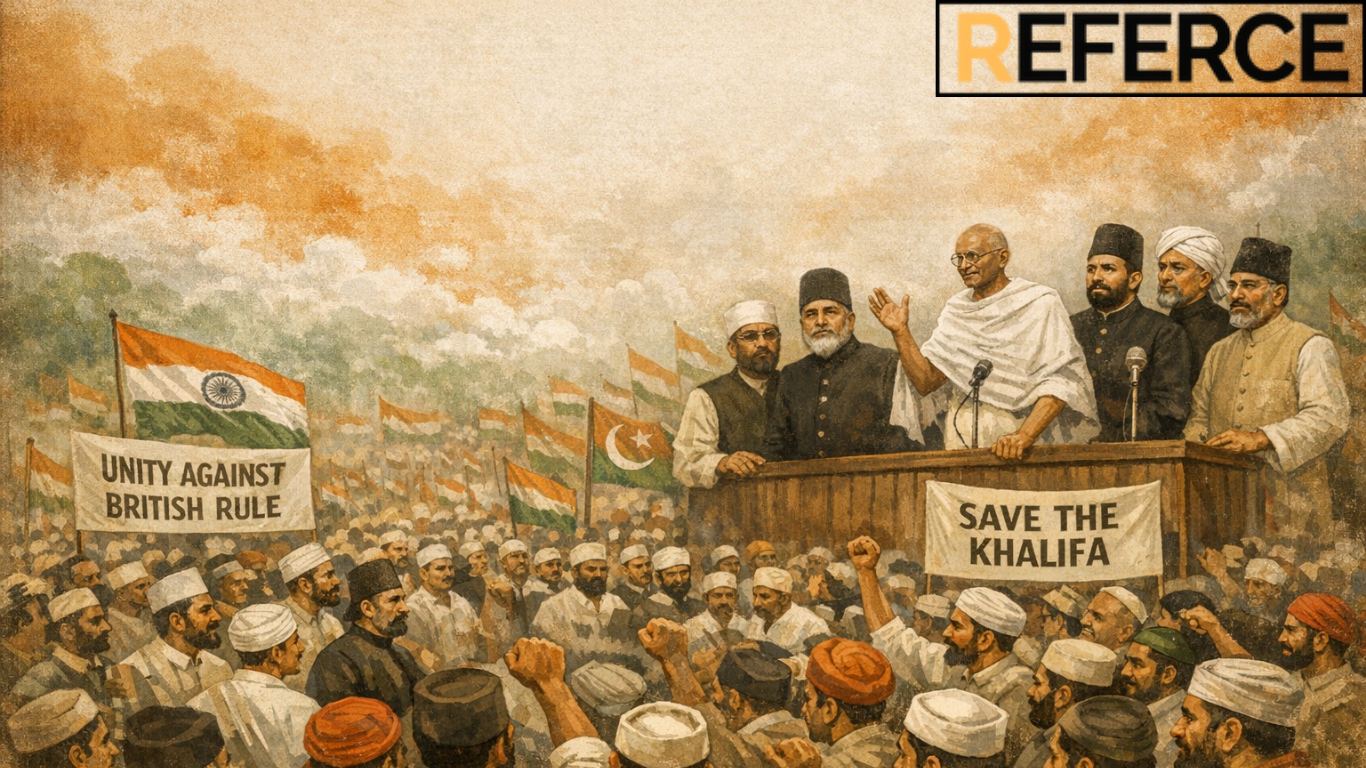
The Khilafat Movement was an integral part of India’s freedom struggle. It started in 1919 and saw Indian Muslims and Hindus unite against the British. The movement was initiated to protect the Khalifa of Turkey, who was considered the religious leader of Muslims globally.
Simultaneously, Indian leaders also viewed this as an opportunity to unite against the British government. The Khilafat Movement in India later allied with Mahatma Gandhi’s Non-Cooperation Movement. This collaboration made the freedom struggle robust.
In this blog, you will learn about the Khilafat Movement of
1919, its causes, its leaders, and its significance for India’s freedom.
What is the Khilafat Movement?
The Khilafat Movement was a protest initiated by Indian Muslims after World War I. The British had defeated Turkey during the war. However, they planned to strip the powers of the Turkish Sultan, who was also called Khalifa.
Indian Muslims believed that this Khalifa was their religious head. When the British attempted to strip him of power, Muslims in India felt hurt and began to protest. They initiated the Khilafat Movement.
The key objectives of the movement were:
To protect the position of the Khalifa
To oppose British policies
To unite Indians against foreign rule
Khilafat Movement 1919: Historical Background
The Khilafat Movement of 1919 started soon after the end of World War I. The British government had promised to treat Turkey fairly. However, they did not keep their promise.
In 1920, the Treaty of Sèvres was signed. This treaty stripped Turkey of most of its land and power. Indian Muslims were angry about this insult to their faith.
At this time, Indians were already angry with British rule due to:
High taxation
Lack of freedom
The Jallianwala Bagh massacre in 1919
This situation allowed the Khilafat Movement to gain momentum in various parts of India quickly.
Causes of Khilafat Movement
There were multiple causes of the Khilafat Movement in India. Some of these causes are explained below.
British Actions Against Turkey
Post World War I, the British and their allies wanted to eliminate Turkey.
British actions led to concern among Muslims in India regarding how this would affect the power of the Khalifa.
Religious Feelings
The Khalifa was seen as the protector of Islam’s holy places. Thus, any threat to his power was highly offensive to Muslims.
Broken Promises by the British
The British assured Indian Muslims that they would treat Turkey fairly after World War I. When they failed to do so, it led to a loss of trust between the Muslims and the British.
Growing Anger in India
Events like the Rowlatt Act and Jallianwala Bagh led to increased anger towards British rule. The issue of Khilafat became one more reason for Indians to protest against them.
Leaders of Khilafat Movement
A few very notable leaders spearheaded the movement and gained support across the country.
Ali Brothers
Maulana Mohammad Ali and Maulana Shaukat Ali were the main leaders behind the Khilafat movement.
They traveled extensively throughout India and encouraged more individuals to participate in this protest.
Maulana Abul Kalam Azad
Another leader who played a key role was Maulana Abul Kalam Azad.
His contribution to the Khilafat Movement included supporting it and advocating for Hindu-Muslim unity.
Mahatma Gandhi
Even though he was not a part of the Islamic community, Mahatma Gandhi integrated himself into the Khilafat Movement.
Gandhi was excited to see that this would be an excellent opportunity for Hindus and Muslims to unite against British rule.
Other Leaders
Many local religious and political leaders also contributed to spreading awareness about the movement.
Khilafat and Non-Cooperation Movement
One of the most notable aspects of history is how the Khilafat and Non-Cooperation Movement joined forces
In 1920, Mahatma Gandhi allied with various leaders of the Khilafat Movement. They began a new form of protest against the British government.
This new form of protest focused on Indians refusing to cooperate with their rules and systems. The objectives were simple — Indians should no longer abide by laws enforced by the British government.
Various actions were taken up by communities and ordinary citizens, such as:
Boycotting schools and colleges run by the British
Leaving government jobs
Boycotting foreign goods
Returning medals awarded by the British government
This alliance made it an even more powerful movement than before. Many Indians actively participated in this phase of the movement.
Spread of the Khilafat Movement in India
The Khilafat Movement in India spread quickly across several regions in India.
People organized public meetings, rallies, and protests in different cities and towns.
Many students left schools run by the British Government.
Many lawyers refrained from practicing in courts run by the British Government.
A significant number of Indian citizens started using products made in India instead of foreign products.
The movement became a mass protest and demonstrated citizens’ strength when they united.
Challenges Faced by the Movement
Even though it was a strong movement, it faced several challenges during its existence.
Government Repression
The government arrested a number of leaders involved in the movement.
They also banned public meetings that were arranged or spearheaded by these leaders.
Violence in Some Areas
In some areas, protests became violent. This went against Gandhi’s principles.
Moplah Rebellion
In Kerala, there was a separate local uprising that weakened community unity with their cause.
End of the Khilafat Movement
The Khilafat Movement ended in 1922 or slowly started to decline around this time.
The reasons for this included:
The Chauri Chaura incident, where protesters became violent
Gandhi called off the Non-Cooperation movement
Major developments were taking place in Turkey at this time
In 1924, Mustafa Kemal Atatürk ended the system of Khalifa in Turkey. After this announcement, there was no purpose behind continuing this movement.
Impact of the Khilafat Movement
Even though it ended, there were several impacts that people saw as a result of the Khilafat movement.
Mass Political Awareness
For the first time, people witnessed ordinary people participating in politics without being forced to do so by political figures or leaders
Hindu-Muslim Unity
The movement demonstrated that people from different communities could work together for a single cause or objective.
Strength to Freedom Movement
The movement gave strength to the Indian National Congress and helped it expand as an organization that masses of people could join without fear
Beginning of Mass Movements
The success of public protests motivated others to use this technique as their only form of protesting against British rule.
Importance of the Khilafat Movement in Indian History
The Khilafat Movement is regarded as one of India’s major movements against colonialism, primarily due to its:
Strong unifying effect on various communities involved in India’s colonial past
Advocating for religious issues alongside political action
Combining public relations efforts and political activity
Indicating how powerful (and successful) public non-cooperation is against colonialism
Conclusion
The Khilafat Movement became more than just a religious protest about how Muslim citizens were treated under colonial rule by some government members But it became a strong political movement that unified people across India against the rule led by foreign governments, specifically targeting citizens who were Indian.
The Khilafat Movement of 1919 played a massive role in increasing public involvement and interest in protesting against their colonial rulers.
With exceptional leaders behind them, mass support from Hindu and Muslim communities, and even its connection with other movements like the Non-Cooperation Movements, it paved the way for freedom fighters across India.
Even though the movement has come to an end, it surely remains a part of history that many recall even today,
so if want too continue reading other topics.